
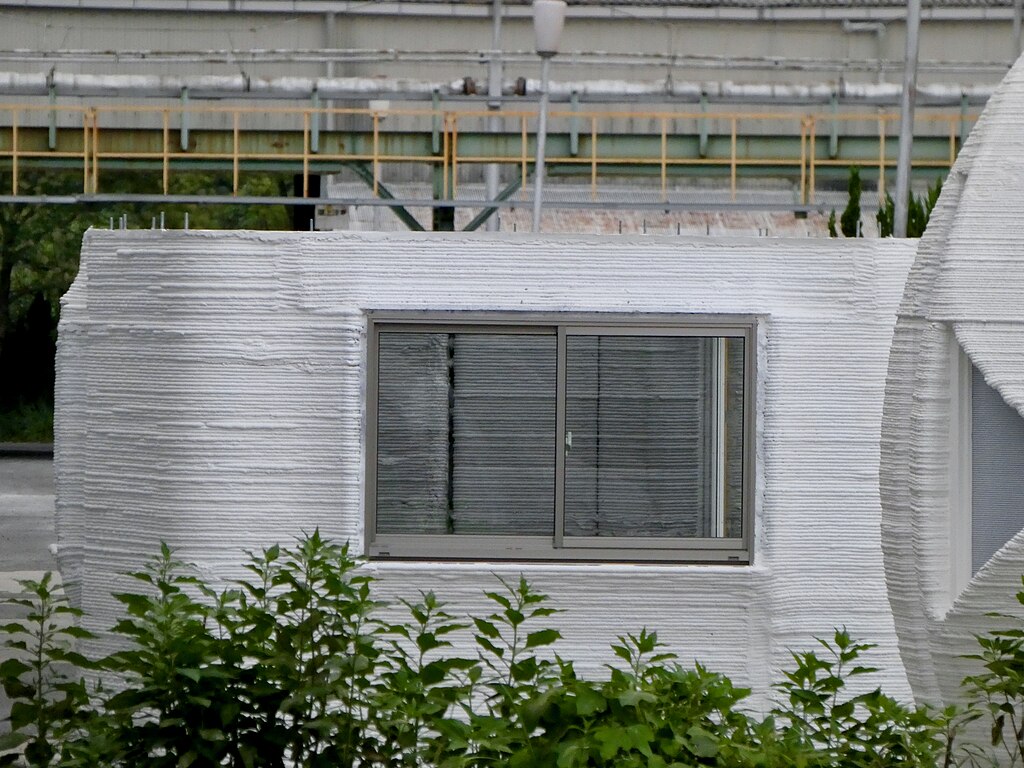
Mixing hemp into 3D-printed concrete introduces clear mechanical tradeoffs that at the moment restrict its structural purposes, based on a latest examine in Australia.
Assessments confirmed that resistance to bending and cracking fell by 57–60.6% in contrast with standard concrete mixes. In contrast, load-bearing capability underneath compression dropped by a smaller, although nonetheless vital, 45.9–54.8% relying on print route. The imbalance issues: supplies that crack simply face steep hurdles in load-bearing use, particularly in layered 3D-printed methods.
The findings come from civil engineering and supplies researchers at Western Sydney College, whose examine was printed within the Journal of Constructing Engineering. The work is the primary systematic experimental evaluation of robotic 3D concrete printing (3DCP) utilizing hemp shivs within the combine, transferring past earlier proof-of-concept trials.
The Journal of Constructing Engineering is a peer-reviewed development and supplies journal printed by Elsevier, one of many world’s largest tutorial {and professional} science publishers.
The science
In sensible phrases, compressive power measures how a lot weight a fabric can safely maintain, resembling supporting a wall or roof. Flexural power measures how nicely it resists bending and cracking — a vital issue for panels, printed partitions, and layer-to-layer bonding in 3DCP. On this examine, flexural efficiency degraded extra sharply than compressive efficiency, growing the chance of cracking at printed layer interfaces.
The researchers created printable mixes by changing a small portion of the sand in commonplace concrete with hemp shivs — the woody interior core of the hemp stalk. Between 1 and 4% of the sand was substituted with hemp. In contrast with standard concrete mixes, the hemp-enhanced materials flowed extra simply via the printer nozzle — a couple of 16.7% enchancment — with out materially affecting the soundness of printed layers.
That processing profit got here at a excessive mechanical value. Power losses confirmed up no matter how the fabric was printed, pointing to a standard drawback in 3D-printed development: the fabric performs in a different way relying on the route during which it’s printed.
Restricted enviro profit
On the low hemp content material used within the examine — roughly changing 1–4% of the sand within the combine — the environmental profit is actual however restricted. Hemp hurd does retailer biogenic carbon and barely reduces the usage of mined supplies, nevertheless it doesn’t materially change the cement content material, which stays the dominant supply of embodied carbon. At these ranges, hemp features as a minor additive slightly than a real substitute, that means the combo shouldn’t be characterised as low-carbon or climate-positive based mostly on composition alone.
Claims round more healthy buildings – legit in conventional hempcrete – are additionally restricted at such a low degree of hemp content material. In contrast to conventional hemp-lime methods that include a lot greater ranges of plant materials, hemp particles on this combine are absolutely sure inside a cement matrix and don’t meaningfully have an effect on indoor air high quality, moisture regulation, or occupant well being. The first worth of the analysis is subsequently not near-term environmental or well being impression, however proof that small quantities of plant materials can work inside automated 3D-printing methods — a needed early step towards greater bio-content supplies sooner or later.
Sobering
From an investor perspective, the implications are sobering. Structural concrete merchandise should meet conservative constructing code and certification requirements, most of that are written round conventional forged concrete. Supplies displaying giant reductions in bending resistance would face tough and time-consuming approval pathways, in addition to potential resistance from insurers, regulators, and engineers of file.
The examine factors to doable enchancment routes, together with pre-treating hemp shivs and refining particle measurement distribution to enhance bonding between printed layers. However these steps would add processing complexity and price — components that might slender hemp’s financial benefit over standard supplies.
Purposes restricted
Within the close to time period, the outcomes counsel hemp-based 3D-printed concrete is best suited to non-load-bearing purposes, resembling inside partitions, insulation parts, or architectural options, the place cracking threat and structural certification necessities are decrease.
Whereas the analysis confirms that hemp can operate inside automated 3D printing methods, it additionally highlights a large hole between technical feasibility and business readiness — notably for load-bearing development ruled by strict codes and certification frameworks.