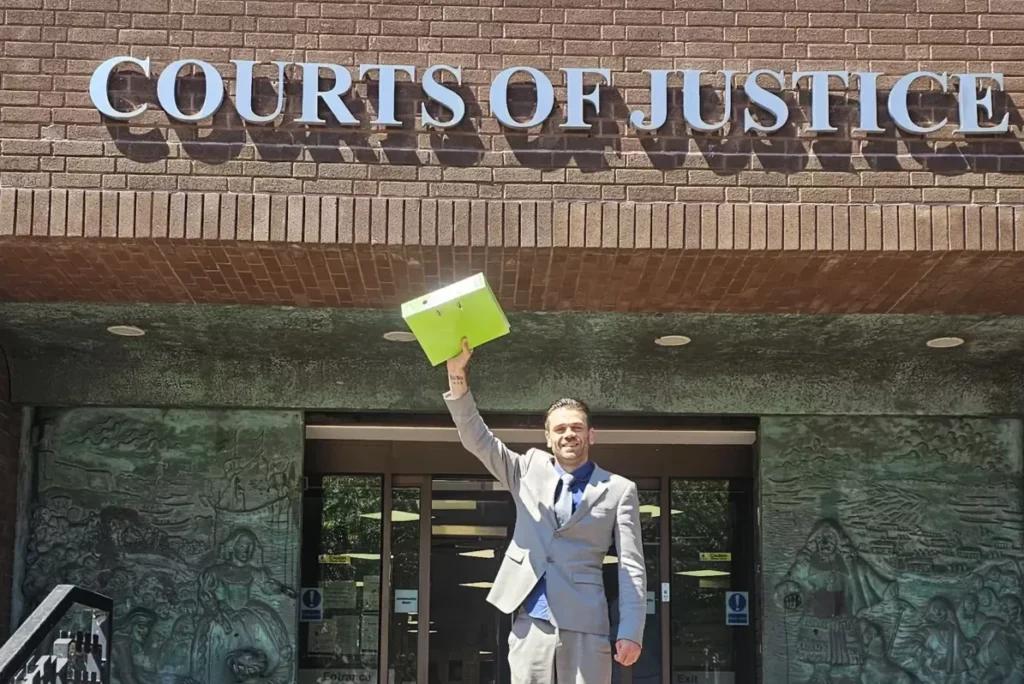
A UK Crown Court docket has thrown out legal costs towards CBD hemp flower importers after ruling that police mishandled proof and used improper testing strategies, however solely after a five-and-a-half-year ordeal that destroyed the defendants’ companies and compelled them to relocate overseas.
Whereas the win provides a possible defence for different hemp importers going through comparable prosecutions, the UK’s exit from the European Union has meant hemp companies are actually ‘extra susceptible than ever’.
Joseph Musumeci, former director of Chichester-based Buds R Us, and his former enterprise accomplice Sean Osborne noticed police raid their premises, freeze their financial institution accounts, and label them an organised crime group earlier than misplacing the seized proof for 4 years.
When authorities lastly examined the merchandise in April 2025, simply weeks earlier than trial, they didn’t observe necessary EU testing protocols. Whereas Decide David Melville discovered that continuity of the proof had been established regardless of the police’s poor dealing with, he dominated that the improper testing strategies made the proof inadmissible.
The July 2025 ruling marks the primary time a UK courtroom has excluded hashish check outcomes particularly on the grounds that police didn’t adjust to EU Regulation 639/2014 Annex III, the necessary testing protocol for figuring out THC content material in hemp merchandise through the interval when the UK was topic to European legislation.
The Case and Its Collapse
The prosecution started when parcels containing CBD hemp flower had been intercepted by customs and Border Power in late 2019 and early 2020.
“We had been stocking round 70 outlets from West Sussex to Scotland. Issues had been going nice, then we had parcels seized by customs,” Musumeci defined. “It wasn’t something uncommon as a result of it seems to be like hashish, however in mainland Europe usually they check it after which see that it’s CBD hemp.”
Musumeci says he has had CBD flower seized, examined, and returned, often inside a number of weeks in different European international locations, together with the Czech Republic, Germany, France, and Austria.
“Nowhere else however within the UK have we been subjected to such heavy-handed therapy and gross misconduct by the police.”
Nevertheless, Royal Mail postal employees took packages they stated smelled of hashish to Sussex Police, the hemp was instantly handled as hashish and a legal investigation was launched.
This noticed them seize roughly 50kg of product and set off costs of hashish importation and conspiracy to provide a managed substance towards Musumeci, Osborne, and 5 others.
Regardless of the enterprise homeowners explaining their merchandise had been authorized CBD hemp underneath EU legislation and repeatedly requesting assessments to show this, Musumeci says they had been refused.
“The whole lot was registered. However they didn’t hassle testing the stuff for no less than a yr… They had been saying it didn’t matter what the THC degree was, that any flower or hemp was unlawful. That was nonsense on the time as a result of we had been a part of the European Union and guarded by the free motion of products underneath Article 36,” Musumeci recalled.
“The police got here down on all of us actually laborious. They raided a number of addresses, froze all our financial institution accounts, shut the web site down, seized property… all the things.”
Police labelled the defendants as an organised crime group and proceeded with legal costs with out testing the seized materials, earlier than apparently misplacing the proof.
The seized hemp flowers went lacking and remained unaccounted for till February 2025, almost 4 years after the seizure. Testing was not carried out till April 2025, simply weeks earlier than the trial commenced, forcing the defence to arrange with out figuring out what the prosecution’s scientific case could be.
Throughout cross-examination by defence counsel Charles Langley KC, Detective Constable Holmes was confronted with proof that police had misplaced 9 completely different reveals within the case. When questioned in regards to the lacking proof, DC Holmes insisted the reveals “weren’t utterly lacking… they weren’t the place we’d count on them to be”.
The case dragged on for 5 and a half years, throughout which period the defendants’ companies collapsed underneath the load of frozen property, legal costs, and the lack to function.
When the prosecution lastly introduced check outcomes exhibiting THC ranges of 0.3% and 0.4%, the defence challenged each the chain of custody and, critically, the testing methodology utilized by prosecution skilled Jagdish Patel of Eurofins Forensic Providers.
In a voir dire listening to (a trial inside a trial the place the decide determines whether or not proof is admissible), Patel admitted underneath cross-examination by Langley that Eurofins had not adopted the EU’s Annex III testing protocol in a number of materials respects. The laboratory used methanol as a substitute of the prescribed squalane reagent, didn’t grind samples as required, used completely different pattern sizes, didn’t apply centrifugal power as mandated, and reported outcomes to just one decimal place slightly than the required two.
Most importantly, Patel conceded that ‘had he used the strategies showing in Annex III one could get completely different outcomes and one wouldn’t know the variations except the assessments had been carried out aspect by aspect,’ in keeping with Decide Melville’s written ruling.
Patel additionally acknowledged he had by no means examined for low THC content material earlier than and that his laboratory’s accreditation testing confirmed share variations from scheme check scores of 17.34% and 22.48%, variations that tackle higher significance when measuring THC ranges close to the 0.2% authorized threshold.
Decide Melville dominated that the prosecution was ‘obliged to check the reveals in keeping with Annexe III’ and had ‘failed to take action.’ He concluded that admitting the flawed check outcomes would have ‘an hostile impact on the equity of the case.’
In his written ruling, the decide was unsparing in his evaluation of the authorities’ conduct: “The prosecution has introduced this example fully upon itself having misplaced/mislaid the reveals for no less than 4 years after which going about their testing regime in a manner they might have simply averted by reference to Annex III.”
Following the ruling, the prosecution supplied no proof towards all seven defendants, and the decide directed the jury to return not responsible verdicts on all counts.