BOL-Shit: Why Federal Drug Sentencing Is Designed to Punish the Poor Whereas Banks Stroll Free
The US Sentencing Fee simply carried out amendments to federal drug sentencing tips that may, theoretically, scale back a few of the most egregious injustices within the system. Beginning November 1st, 2025, the Base Offense Stage—the numerical rating figuring out sentence severity—might be capped at 32 for individuals with “mitigating roles” in drug offenses, doubtlessly decreasing sentences for couriers, lookouts, and low-level distributors who have been beforehand handled as in the event that they have been cartel kingpins.
This appears like progress till you perceive what it is fixing: a system so basically damaged, so intentionally designed to inflate sentences for the poorest and most weak defendants, that calling it “justice” requires willful delusion. The BOL system—pun completely supposed—is full bullshit. It is an arbitrary scoring mechanism that transforms street-level sellers into main traffickers via mathematical manipulation, sentencing calculations that deal with amassed small quantities as large portions, and conspiracy legal guidelines that maintain couriers accountable for medicine they by no means touched.
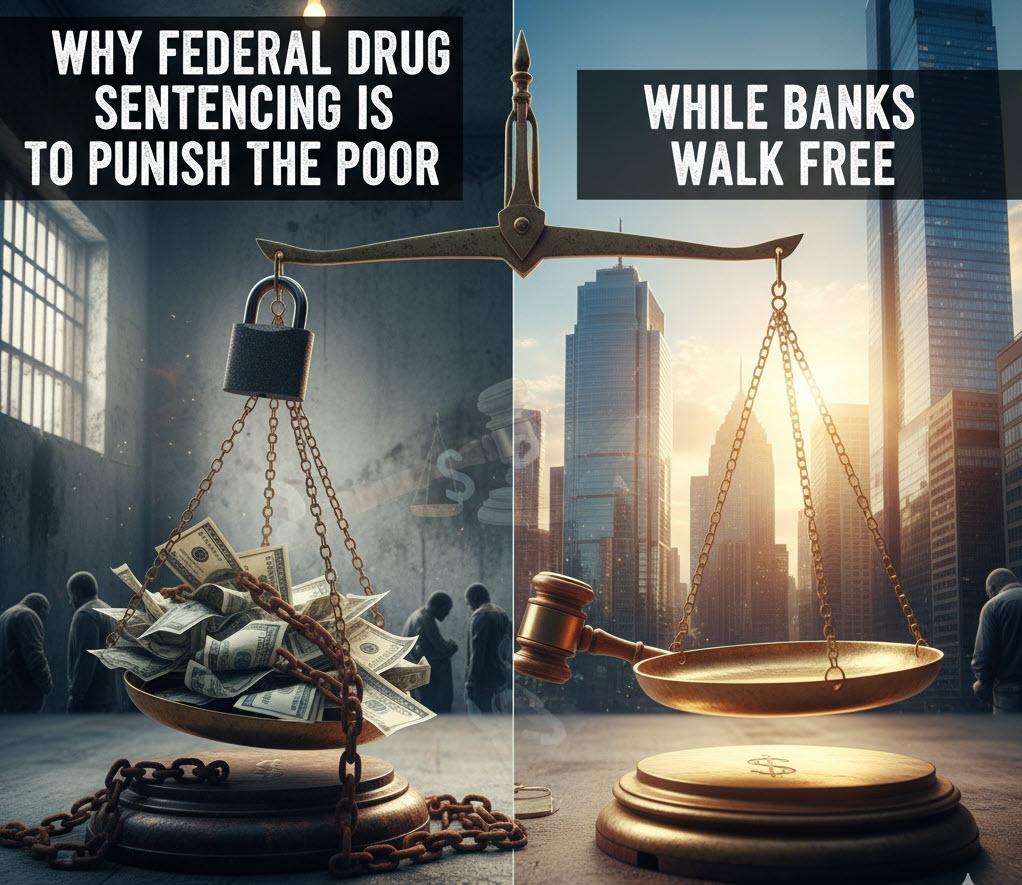
In the meantime, banks that launder billions in cartel income—HSBC alone processed $881 billion in suspicious transactions linked to Mexican and Colombian drug cartels—face deferred prosecution agreements and fines that quantity to cost-of-doing-business. No executives go to jail. No financial institution officers obtain BOL scores. The establishment pays a penalty smaller than its quarterly income and continues working as if nothing occurred.
This is not unintentional. That is the system working precisely as designed: punishing poor individuals, disproportionately Black and Latino, for low-level participation in drug distribution whereas defending rich establishments and people whose involvement dwarfs avenue sellers by orders of magnitude. The brand new sentencing amendments are a Band-Support on a gunshot wound. All the framework deserves to be dismantled and rebuilt from ideas of proportionality, fairness, and precise justice slightly than the present equipment of sophistication warfare disguised as drug coverage.
The BOL System: Arbitrary Numbers, Life-Destroying Penalties
Federal sentencing operates via a convoluted scoring system that assigns every defendant a Base Offense Stage between 1 and 43 based mostly on perceived seriousness of the offense. For drug trafficking, BOL is set partly via a Drug Amount Desk that makes use of grams concerned to assign scores that—previous to amendments—ranged from 6 to 38. Greater scores imply longer sentences, with BOL 37 or larger doubtlessly leading to life imprisonment relying on legal historical past.
Here is the primary drawback: two-thirds of individuals sentenced for drug trafficking obtained BOLs between 30 and 38, that means the overwhelming majority of defendants have been being scored within the highest severity ranges regardless of most being low-level contributors. This wasn’t random distribution—it was systematic inflation constructed into how amount is calculated and the way roles are assessed.
The Drug Amount Desk treats all medicine as in the event that they’re equal in hurt and market construction, which is absurd. It equates substances with vastly totally different pharmacology, dependancy potential, and social affect. Methamphetamine—in contrast to nearly all different substances—is criminalized in accordance with purity slightly than amount, that means defendants face enhanced sentences not for distributing extra drug however for the drug being larger high quality. Over 80% of drug trafficking instances with BOL 38 concerned meth, demonstrating how this purity-based system systematically inflates sentences.
The amount calculation itself is designed to maximise scores. Should you’re a neighborhood vendor transferring small quantities over time, prosecutors can mixture each transaction throughout months or years to achieve a lot larger whole portions. A vendor transferring just a few grams weekly might be charged as in the event that they trafficked kilos by merely including up weeks of exercise. The regulation does not distinguish between somebody transferring 100 grams without delay and somebody who moved 5 grams weekly for 20 weeks—each get charged with 100 grams.
Conspiracy expenses compound this inflation. Beneath federal conspiracy regulation, every member of a conspiracy is held accountable for the “fairly foreseeable” drug portions concerned in your complete conspiracy, not simply their particular person position. A courier who transported medicine twice might be held accountable for each kilogram the group moved through the interval they have been concerned. They by no means noticed most of these medicine, by no means profited from them, by no means managed distribution—however they’re sentenced as in the event that they did.
The “related conduct” doctrine permits judges to think about uncharged and even acquitted conduct when figuring out sentences. This implies a defendant discovered not responsible of sure expenses can nonetheless have these acquitted expenses improve their BOL and lengthen their sentence. You might be discovered not responsible past cheap doubt however nonetheless punished for a similar conduct below decrease evidentiary requirements throughout sentencing.
Prior convictions—even for minor offenses—improve legal historical past scores that multiply BOL penalties. Somebody with earlier drug possession convictions faces dramatically longer sentences than first-time offenders for equivalent conduct. This creates cascading punishment the place early encounters with the system make escape more and more not possible.
Designed to Inflate: Why the System Crushes Low-Stage Sellers
The BOL system is not simply flawed—it is deliberately designed to provide harsh sentences for individuals on the backside of drug distribution networks whereas offering mechanisms for leniency towards these larger up who can cooperate with prosecutors.
Low-level defendants sometimes cannot present precious info. A avenue vendor or courier is aware of their instant supervisor and perhaps just a few friends, however they do not know organizational construction, management, or monetary operations. They don’t have anything prosecutors need. Excessive-level defendants know the whole lot—provide chains, cash laundering, management, corruption networks. They’ve the whole lot prosecutors need.
The “substantial help” departure permits judges to condemn beneath guideline ranges if defendants present precious cooperation to prosecutors. This overwhelmingly advantages higher-level offenders who’ve info value buying and selling. The courier will get the harshest sentence as a result of they cannot cooperate meaningfully. The regional distributor will get a lowered sentence as a result of they recognized suppliers. The result’s that organizational management usually receives lighter punishment than low-level contributors.
The sentencing amendments acknowledge this perverse dynamic by capping BOL at 32 for defendants with “mitigating roles”—these serving as couriers, operating errands, performing as lookouts, or performing “low-level trafficking features” like distributing user-level portions for little compensation or with motivations apart from revenue. The rules now acknowledge that non-public relationships or coercion may drive participation, not legal ambition or revenue motive.
This helps. A BOL of 32 means sentences roughly between 10 and 22 years as a substitute of potential life imprisonment. But it surely nonetheless treats a courier motivated by desperation or coercion as deserving a decade-plus in jail. It nonetheless fails to acknowledge that “mitigating position” describes the overwhelming majority of individuals caught in federal drug instances—people who find themselves economically determined, coerced by circumstances, or working at subsistence ranges whereas taking huge authorized dangers for minimal financial acquire.
The fentanyl-related amendments present comparable dynamics. Beforehand, anybody convicted involving fentanyl confronted a four-level sentencing enhancement in the event that they “knowingly misrepresented” a substance as not containing fentanyl. In 2023, this was lowered to 2 ranges if consciousness was characterised as “willful blindness.” Now it may be utilized for “reckless disregard,” which prosecutors will use extra extensively. This appears like leniency till you acknowledge it is nonetheless enhancing sentences for individuals who seemingly did not know what they have been transporting or promoting—the system simply discovered a decrease culpability customary to use the enhancement extra usually.
Banks Launder Billions, Pay Fines, Stroll Free
Whereas the BOL system crushes low-level sellers with decade-plus sentences for transferring small portions, banks laundering cartel billions face deferred prosecution and fines that do not even seem on government stability sheets.
HSBC offers the paradigmatic instance. Between 2006 and 2010, the financial institution processed $881 billion in suspicious transactions with connections to Mexican and Colombian drug cartels. This wasn’t passive negligence—HSBC intentionally weakened anti-money laundering controls to facilitate cartel banking. Mexican branches accepted $7 billion in money deposits, usually in containers designed to suit teller home windows, whereas compliance officers regarded the opposite approach. The financial institution supplied monetary infrastructure that enabled cartel operations on a scale no avenue vendor may think about.
When this got here to gentle in 2012, HSBC confronted legal prosecution. As a substitute, they obtained a deferred prosecution settlement and paid $1.9 billion in fines. No executives confronted expenses. Nobody went to jail. The financial institution’s inventory worth recovered inside months. The wonderful represented roughly 5 weeks of HSBC income—a rounding error for an establishment that had enabled almost a trillion {dollars} in suspicious transactions.
Examine this to the courier transporting 100 kilograms who receives a BOL of 38 and faces a long time in jail or life. The courier dealt with $2-3 million in medicine. HSBC facilitated motion of tons of of billions. The courier will get life. The financial institution will get a wonderful.
This is not an remoted case. Wachovia (now Wells Fargo) laundered $378.4 billion for Mexican and Colombian cartels between 2004 and 2007. They obtained a deferred prosecution settlement and paid $160 million in fines—lower than 2% of the financial institution’s 2009 revenue. No people confronted expenses.
The double customary is obscene. When banks launder cartel cash, prosecutors declare legal prosecution would destabilize monetary markets. When avenue sellers transfer small portions, prosecutors declare harsh sentences deter crime and defend communities. The truth is that banks present infrastructure that allows cartels to function at scale, changing drug proceeds into authentic capital that may fund violence, corruption, and territorial management. With out cash laundering, cartels cannot operate. They want banks greater than they want avenue sellers.
But the BOL system applies solely to people, not establishments. There isn’t any Base Offense Stage for companies that facilitate cartel operations. There isn’t any Drug Amount Desk measuring laundered {dollars} as a substitute of trafficked grams. There isn’t any conspiracy legal responsibility holding financial institution executives accountable for foreseeable penalties of intentionally weakened compliance packages.
That is by design. The legal justice system exists to manage poor populations, not rich establishments. When low-level sellers are systematically crushed with inflated sentences whereas banks enabling billion-dollar cartel operations face negligible penalties, the message is obvious: justice is for individuals who cannot afford legal professionals to barter deferred prosecution. Everybody else will get the BOL system.
The Sticky Backside Line: Reform the System or Burn It Down
The November 2025 sentencing amendments symbolize marginal enchancment in a basically unjust system. Capping BOL at 32 for mitigating roles will stop some life sentences for couriers and lookouts. Increasing the reckless disregard customary for fentanyl enhancements may scale back some extreme punishment. These modifications assist people caught within the system’s gears.
However they do not deal with the core issues. They do not repair the Drug Amount Desk that aggregates small quantities into large portions. They do not remove conspiracy legal responsibility that holds minor contributors accountable for complete organizational conduct. They do not stop judges from contemplating acquitted conduct throughout sentencing. They do not create BOL scores for banks laundering cartel billions. They do not mandate jail time for executives whose deliberate coverage decisions allow drug trafficking at industrial scale.
The Sentencing Fee thought of amendments to methamphetamine sentencing—the substance most accountable for BOL 38 convictions—however by no means voted on them. The system’s most egregious injustice stays unaddressed as a result of fixing it could scale back sentences an excessive amount of for political consolation.
All the framework is BOL-shit. It is designed to provide harsh punishment for economically determined people whereas defending establishments whose involvement dwarfs street-level participation. It is constructed on arbitrary numbers, amount manipulations, and conspiracy theories that remodel couriers into kingpins. And it operates inside a broader drug conflict that is at all times been about controlling poor and minority populations slightly than decreasing drug hurt or stopping cartels.
Actual reform requires abolishing obligatory minimums, ending conspiracy enhancements, prohibiting aggregation of small portions over time, creating precise proportionality between conduct and punishment, and—most critically—making use of legal legal responsibility to establishments and executives who allow trafficking via cash laundering. Till banks face the identical BOL system as avenue sellers, till executives danger a long time in jail for facilitating cartel operations, the system will stay what it is at all times been: class warfare disguised as drug coverage, crushing the poor whereas defending the highly effective who revenue most from prohibition’s existence.
MARIJUANA SENTENCING, READ ON…